Sunday, March 22, 2020

Keeping Quiet


A friend sent me this. Seems appropriate to post here.


KEEPING QUIET
by Pablo Neruda

Now we will count to twelve
and we will all keep still.

For once on the face of the earth,
let’s not speak in any language;
let’s stop for one second,
and not move our arms so much.

It would be an exotic moment
without rush, without engines;

we would all be together
in a sudden strangeness.

Fisherman in the cold sea
would not harm whales

and the man gathering salt
would look at his hurt hands.

Those who prepare green wars,
wars with gas, wars with fire,

victories with no survivors,
would put on clean clothes
and walk about with their brothers
in the shade, doing nothing.

What I want should not be confused
with total inactivity.

Life is what it is about;
I want no truck with death.

If we were not so single-minded
about keeping our lives moving,

and for once could do nothing,
perhaps a huge silence
might interrupt this sadness
of never understanding ourselves
and of threatening ourselves with death.
Perhaps the earth can teach us
as when everything seems dead
and later proves to be alive.

Now I’ll count up to twelve
and you keep quiet and I will go.

Saturday, March 21, 2020

I Don't Have To Do It All Today

Hello friends.

This is my first post of the COVID-19 American society shut down. My school closed down last Friday and I have now been through one week of preparation for online instruction beginning on Monday. I know that most of you are in the same boat as well.

If you are anything like me, your news feed has been filled with other music educators, parents, and classroom teachers walking through this situation together. My feed has been full of innovative instructional ideas, wonderful musical performances, expressions of fear, faith and hope, and a variety of other fairly intense posts.

If I am being honest, I feel a bit overwhelmed. Don't get me wrong, I am very comfortable teaching in an online or Zoom environment. I am regularly involved in Zoom meetings with organizations around the country and have actually taught Online Beginning Guitar throughout this school year. I have taught numerous interactive video conference classes over the years through NCSSM Distance Education programs. So, the need to go online isn't particularly daunting to me. (However, my wife, who teaches Kindermusik, is completely intimidated by the prospect of Zoom classes. So, if this is brand new to you, I certainly feel your pain.) In the end, the nature of the instruction is not what makes me feel overwhelmed.

Honestly, I believe I have so much information hitting me at one time that I can't seem to sift through it or organize and prioritize how I want to receive that information. I feel like I, too, should be creating and sharing innovative content delivery methods and plans. I feel like I, too, should be recording awesome music in my home studio. I feel like I, too, should be encouraging my colleagues and finding ways to lift my community up. I feel like I, too, should be inspiring my two sons who are at home. I feel like I should be helping my wife get up and running with Zoom. and, all the while, I need to be planning my own curriculum and preparing to support my students through the upcoming weeks and months of uncertainty and disconnection.  I also feel like I need to be getting exercise, making dinner, doing the dishes, and generally continue being a whole human. And, this is hard, because I am used to being the guy who "does it all."

It's all a bit much. So, my message today is that you don't have to do everything. In fact, I would recommend that we all do a little bit less. Have you seen the hilarious video on YouTube of the mother ranting about how much work her kids have?  I have had conversations with colleagues who have small children and they are feeling overwhelmed with their children's work. My 17 year old son doesn't really know how he will complete all of the assignments that he has been given. My 19 year old college freshman is feeling alone and overwhelmed with his work as well. Even my older son who is a graduate assistant is feeling overwhelmed with the amount and type of work that he has to take care of. This feeling seems to be pervasive.  This online and screen environment is exhausting.

So here is my pledge. I am going to do my best to not feel compelled to keep up with the Jones's. I am going to lead with grace and compassion for my students. I am going to do my best to not contribute to their higher stress levels and overwhelmed feeling of not being able to complete their work. I am going to modify my syllabus accordingly. Meanwhile, when the creative bug hits me, and it will, I will do my best to share my heart freely through my art and pedagogy.

I encourage you to do the same. Don't let it overwhelm you. This is hard. We will all get through this together.

Peace.
Scott

Sunday, March 8, 2020

ASTA 2020

Hi Friends!
I am in the airport, heading home from the American String Teachers National Conference which was held in Orlando from March 4-7.  The conference was a huge success and, as always, included wonderful learning opportunities, renewal of old friendships, many new friendships, and a general spirit of community and love that many of us have grown to anticipate and appreciate on an annual basis at the conference.

I was thrilled to conduct the first National Conference Teacher Orchestra on Wednesday and want to thank all who participated.  It was so much fun and everyone seemed to really enjoy making music together. The performance at the opening reception was a blast! Special thanks to Jesus Florido for participating and soloing with us.  We learned so much from you in the rehearsal as well!

Congratulations to Jesus and all of the performers who brought the very first Electric Bowed String Concert to ASTA this year.  It was so much fun and we all appreciate the unbelievable musicianship that was on display on Thursday night.  I am so proud of my history in the electric violin community appreciate each of you!!  Jesus: your love and positive energy was the catalyst for this.  Thanks!!

I also wish to thank thank Brian Hellhake and the students of Freedom High School Orchestra for serving as a demonstration group for my session, along with Jim Palmer, on Sharing Our Secrets: Higher Order Thinking.  The students were magnificent and we really couldn't have asked for anything better.  Thanks, too, to Jim Palmer.  We have so much fun presenting together. We certainly missed Rebecca MacLeod this year.  She was judging the National Orchestra Festival this year, but I am sure our trio will reconvene soon!!

I want to extend a huge congratulations to the ASTA Staff for a magnificent conference.  Monika Schulz has really moved our organization to a new level of professionalism and prominence.  Susan Hoopes was invaluable in my preparation.  Tracey Kratt has been instrumental in forwarding our ASTA Connect social tool.   The whole staff is fantastic.  Also, the ASTA Ambassadors (volunteers from the profession) were such servant leaders. We all appreciate you so much!

I can't begin to name all the new friends and colleagues whom I connected with this week.  Please know that I value each and everyone of you.  The meals, coffee, and hallway conversations were all so valuable and perspective-changing.  Thank you all for your wisdom and encouragement!


And now we all go back our corner of the world to change string kids' lives one student at a time!! We are all filled up and ready to extend that energy to our individual communities.  I can't wait to hear the stories of success again next year!

Peace
Scott

Thursday, March 5, 2020

Sharing Our Secrets: Higher Order Thinking

Hi friends! These are my notes in preparation for our demo group discussion today at ASTA 2020.

As always, I welcome your feedback and thoughts. I hope you find some of this information helpful.

~Scott


Sharing Our Secrets: Higher Order Thinking


In this panel and demo group session, presenters will share tips and secrets that promote higher order thinking in the orchestra and string class setting. Topics will include a variety of approaches to musical problem solving, strategies for promoting independent thinking, musical habits of mind, taxonomy models, engaging students in critical listening, and more. Exercises that challenge and promote musical student independence will be demonstrated. Attendees are certain to enjoy and gain from the panel interaction with students and with each other. Together the presenters represent over 60 years of K-12 classroom experience at every level of instruction.
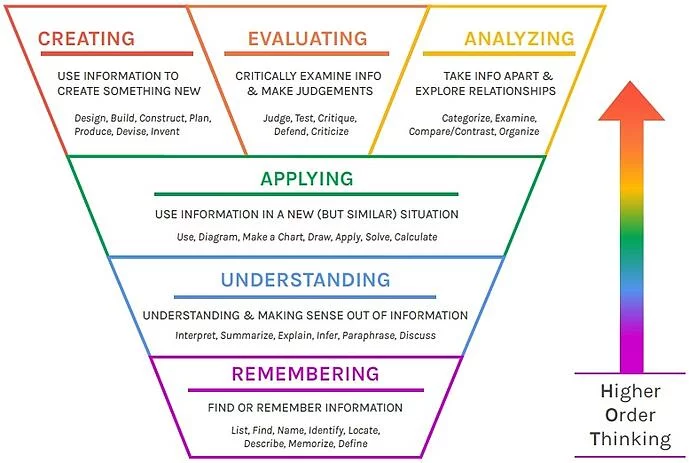


Laird:

Habits of Mind 

  • "Habits of Mind are the characteristics of what intelligent people do when they are confronted with problems, the resolutions of which are not immediately apparent." (Professor Art Costa)

  • Persistence 

  • Managing Impulsivity

  • Listening with Empathy and Understanding

  • Thinking Flexibly

  • Thinking about your Thinking : Metacognition

  • Striving for Accuracy

  • Applying Past Knowledge

  • Questioning and Posing Problems

  • Gathering Data Through All Senses

  • Creating, Imagining & Innovating

  • Responding With Wonderment and Awe

  • Taking Responsible Risks

  • Finding Humor

  • Thinking Interdependently

  • Remaining Open to Continuous Learning


Ensemble Musician’s Taxonomy


  • Accurate Rhythm and Time

Obviously, these are the first steps in learning a piece of music.  Right notes played out of time are wrong notes. So, I place a great deal of emphasis on rhythm early in the rehearsal process.

  • Accurate Notes and Key 

Very close behind rhythm is tonal center and correct notes.  Obviously. The thing is that many teachers never get past this spot in the taxonomy.  This is understandable. If the students are out of tune, this must be corrected.

  • Playing Technique

I try to give all of my students individual technique goals. These can be left or right hand position, bow hold, set up, right had fluidity, vibrato, etc.  Then, they can focus on this when they have learned the basics of their part.

  • Written Dynamics

This is the next obvious step in preparing a part.  It is written on the page, for goodness sake. I encourage my students not to  think about dynamics as some fixed value, but rather to consider them in the context of the overall piece.

  • Fingering/Shifting

This is one of the first big shifts in thinking that I find I can affect.  So many kids think that they only need to shift when the part gets high. I try to change that way of thinking to looking at fingering from a perspective of ease of passage, tone color, and string crossing.

  • Bow Direction and Use

In a perfect world,  this would be higher in the taxonomy.  I feel like this is incorporated into every moment of every rehearsal.  I don't usually over-bow string parts for my orchestra. I want them to be thinking critically about direction as it pertains to style, dynamics, and articulation.  Bow direction is so subjective. I usually have very clear priorities, but I love to articulate them in the context of a great discussion about bow direction.

  • Articulation

This is strongly related to bow direction.  I find that students often come to me with a very limited palette of articulation options.  I try to get them thinking about the initiation of sound throughout the rehearsal process.

  • Vibrato/Tone Production

Vibrato  and tone production are often the difference between an average overall sound and a mature sound.  But, where do changes occur and how can these be varied? These are important questions for each musician to be constantly asking themselves.

  • Artistry/Direction of line

This is where real musicianship develops and emerges.  When we can get a student to think about this independently, they are truly on the way.

  • Tempo/ Push-Pull

This is typically dictated by the conductor, but the students that are intuitive with this can help the group along!

  • Section and Individual Balance

Where do I fit in the dynamic balance of the orchestra? Where does my section fit in the dynamic balance of the orchestra?

  • Section and Individual Role

What is my role in this passage?  What is my section's role in this passage?  Melody? Harmony? Off Melody? Bass line? Engine?  Rhythmic Underpinning? Sustain/Pads? Teacher? Student?  What else?

  • Perspective and Emotion/ Performance


Functional String Improvisation


Defining Functional Musicianship (my guitar/piano class)


Computational Thinking

The characteristics that define computational thinking are decomposition, pattern recognition / data representation, generalization/abstraction, and algorithms.[9][10] By decomposing a problem, identifying the variables involved using data representation, and creating algorithms, a generic solution results. The generic solution is a generalization or abstraction that can be used to solve a multitude of variations of the initial problem.
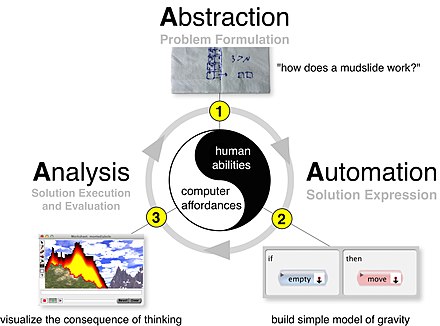
The "three As" Computational Thinking Process describes computational thinking as a set of three steps: abstraction, automation, and analysis.

Another characterization of computational thinking is the "three As" iterative process based on three stages:

  1. Abstraction: Problem formulation;

  2. Automation: Solution expression;

  3. Analyses: Solution execution and evaluation.[citation needed]

The four Cs of 21st century learning are communication, critical thinking, collaboration, and creativity. The fifth C could be computational thinking which entails the capability to resolve problems algorithmically and logically. It includes tools that produce models and visualise data.[11] Computational thinking is applicable across subjects beyond science, technology, engineering, and mathematics (STEM) which include the social sciences and language arts. Students can engage in activities where they identify patterns in grammar as well as sentence structure and use models for studying relationships.[12]


Friday, November 15, 2019

South Carolina Region 2

Hi Friends.
Last weekend I conducted a wonderful Regional Orchestra event in South Carolina. (It was such an honor to work with your students in Region II.) As part of the event, I was asked to present a 1 hour professional development session for the participating teachers.  Initially, I planned to do my Pedagogy from the Podium session which I have presented many times over the years.  But, after my first evening of rehearsals, I decided it would be cool to share some of the broad ideas I was presenting to students as part of the rehearsal process.  I thought the teachers would enjoy hearing some background and context to my musical and ensemble priorities. 


All of these are designed to empower kids as independent musicians.


Pedagogy from the Podium Handout

Pedagogy from the Podium Presentation

I hope that some of this resonates with you and that perhaps your students will bring some of the concepts back to your local school orchestra.
Again, thanks for having me this weekend!!

Peace.
Scott

Tuesday, October 29, 2019

WSFCS Professional Development Day - October 29, 2019

Hello to my friends from Winston Salem Forsyth County!

I am looking forward to sharing some of my ideas with you today!

Here are some resources for the day:

Finger Patterns:

Full Explanation and links

Handout

My Finger Pattern Documents (Sheet Music, Explanations, etc.)


Quick Link to Violin Finger Pattern Exercises on Youtube

NCSSM Finger Pattern Playlists: All Instruments and Major Scales


The Habit Loop

All Materials


I hope you find the professional development sessions useful today!

All my best.
Scott

Thursday, October 17, 2019

Reliably Bad with the NCSSM Orchestra

Reliably Bad will be performing a free concert with the NCSSM String Orchestra at NCSSM on Friday, Oct. 25 at 7 p.m. in the ETC Auditorium. Reliably Bad is a Greensboro-based funk-pop 8-piece band who are making waves in the N.C. music scene with their original music. All graduates or current students of the UNC-Greensboro School of Music, each member brings a variety of influences and musical styles to the table. This will be their first time performing with an orchestra backing them up, and they have been hard at work creating orchestral arrangements for this show. (Bandmember Christopher Peebles is currently doing all of the string arrangements.) This high-energy concert is sure to be a great way to celebrate the end of first trimester classes! Check out their new single and this recent article.  This is a free concert and families with children are welcome!!


Here is their Bandcamp page with some more tunes:  https://thereliablybadband.bandcamp.com/album/the-college-ruled-ep

I am really looking forward to doing this non-classical orchestra performance with our orchestra students and Reliably Bad. It will be a completely different experience from a traditional orchestra performance and everyone gains from it. The band is fantastic, and I feel like their boundless energy and musical expertise will certainly transfer to our orchestra musicians. Also, it will be great fun!  - Scott Laird